
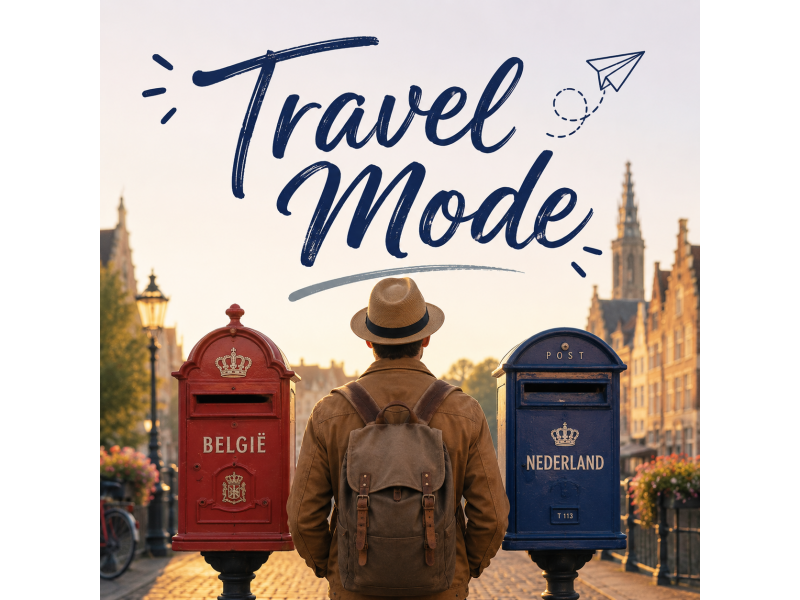
In short: Travel Mode is a postcrossing feature for trips. It lets you send official postcards from the country where you are currently staying, receive a local ID and make your journey part of your postcrossing statistics.
You are probably used to the calm rhythm of postcrossing: request an address, choose a postcard from your personal collection, write it, add a stamp and drop it into the mailbox. But what if a long-awaited vacation or a work trip is coming up? Your favorite hobby does not have to “wait” until you come back home.
True postcrossing fans know that postcards sent during a trip are the best kind of souvenir. And the official project website has a special tool that lets your hobby travel with you. It is called Travel Mode.
In this article, we will look at how this mode works, why it gives you unique IDs, and tell an absolutely incredible story about how one postcrosser managed to send postcards from two countries without even leaving one town.
1. Why do you need Travel Mode and what happens to the ID?
Imagine walking through the streets of Lisbon or exploring castles in Germany. Of course, you may want to send a postcard right from there. But if you simply request an address using your usual home profile, the system will register the card as sent from your home country. As a result, your statistics will be off, and the recipient may be confused to find a German stamp on a postcard with a Russian ID.
This is exactly what Travel Mode is for. By activating it, you temporarily change your sending location. The most exciting part is the change in the postcard’s country code. As soon as you request an address while you are in Germany, your postcard receives a proper German ID (DE); in Portugal, a Portuguese one (PT), and so on. It is a wonderful little exclusive for your personal sending statistics.
2. The technical side: how does it work?
Step by step, it looks like this:
- before your trip or right after arrival, go to your Account Settings;
- switch your status to Travel Mode;
- choose the country and city you want to send postcards from;
- request addresses from your travel location;
- buy local postcards and stamps;
- send the postcards through the local postal service.
The main geolocation rule: to get an address with a foreign ID, you must physically be in that country. The postcrossing system automatically checks your IP address.
Important: if you use mobile internet while roaming, your traffic is often routed through servers in your home country. Because of this, the website may “think” that you are still at home and may not allow you to request an address. The solution is simple: connect to local Wi-Fi at a hotel, airport or nearby cafe.
What happens to incoming postcards? While you are traveling, your address is temporarily excluded from the address pool, because you are not at home and there is no one to receive your postcards. All the cards that are “owed” to you will start being assigned to other users only when you return and switch your profile back to Active.
3. How to double the fun: The Baarle Experience
If you think Travel Mode is just a convenient feature, the story of a postcrosser named Frank, username xmyrxn, may change your idea of what is possible. Not long ago, he traveled to the town of Baarle and created a real postal performance there.
The thing is, Baarle is a unique place on the border of two countries. It is not just one town, but literally two territories in one: Baarle-Nassau in the Netherlands and Baarle-Hertog in Belgium. The town is a complicated puzzle of enclaves and exclaves. Belgian pieces of land lie inside the Netherlands, and inside them there may be Dutch “islands” as well.
The border is so unusual that it runs straight through streets, shops and even residential houses. The nationality of a house is determined by which country its front door opens into. On the streets, you can see white crosses with the letters NL and B marking the national border.
Baarle has two postal systems at once: the Belgian bpost and the Dutch PostNL. Frank decided to make the most of this geographical anomaly.
What he did:
- Found Wi-Fi on the right side of the border. First, Frank connected to free Dutch Wi-Fi in a cozy cafe on the Dutch side and requested postcards with a Dutch ID.
- Moved to the Belgian side. Then he walked just a few meters down the street to a Belgian pub, connected to local Wi-Fi and requested addresses with a Belgian ID.
- Used stamps from two countries. On some postcards, he put stamps from both countries: first he visited the post office in the Netherlands, then the one in Belgium.
- Received postmarks from two countries. Thanks to the helpful staff at the local post offices, he managed to get hand cancellation marks from both countries on the same postcard.
As a result, lucky recipients in different parts of the world received truly unique souvenirs: postcards with the ID of one country, stamps and postmarks from two countries at once, all sent from the same point on the map.
Small tips for travelers
If your route goes through very tiny territories or microstates, such as the Vatican, where there may be issues with national servers and network detection, the postcrossing team recommends contacting support in advance. They can help adjust the account manually.
It is also worth thinking ahead about where to look for postcards with local character. Sometimes souvenir shops in the city center offer more interesting designs than the standard postcard racks at train stations.
The main idea
Travel Mode turns postcrossing into a real adventure. It is a chance to bring back from vacation not just ordinary souvenirs, but tangible pieces of your discoveries that will decorate someone’s collection and your own statistics.
And if you would like to make your postcrossing mail even more beautiful, take a look at our shop: we have not only postcards, but also stickers, stamps, decorative tapes, envelopes and other lovely little things for decorating mail. Everything that helps turn an ordinary postcard into a small journey on paper.