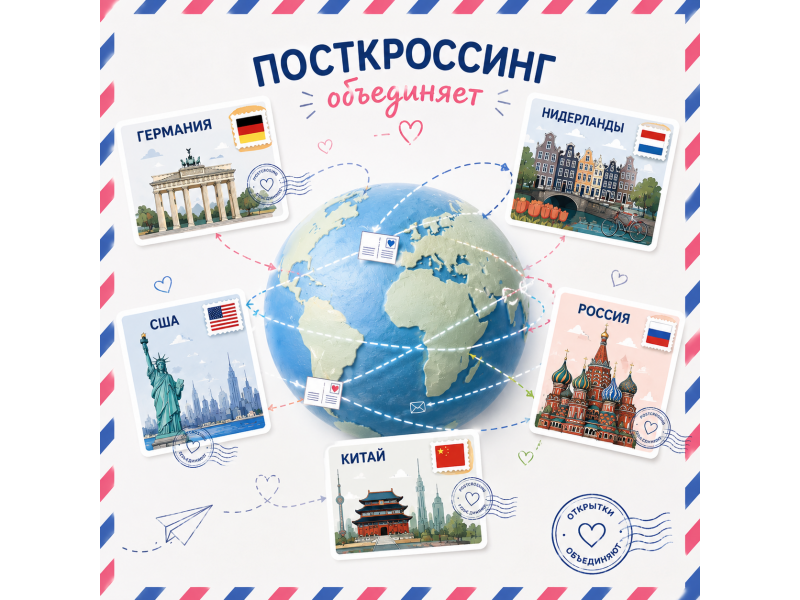
Short answer: if you once again get Germany, the USA, Russia or another very active country, it is not a mistake and not "bad luck". These countries have many postcrossers: they send a huge number of postcards, so their addresses often appear in the system.
A familiar story: you request a new address hoping for something rare - Iceland, New Zealand, a tiny island, a country that is not yet in your statistics. And there it is again: Germany. Then the USA. Then Germany again. And sometimes a small annoyed thought appears: "Why there again?"
So why do countries repeat?
Postcrossing is built on exchange: you send a postcard, the recipient registers it, and after that your address becomes available to another member. The more actively a country sends postcards, the more members from that country are waiting for postcards in return.
The official Postcrossing help explains it simply: some countries are much more active than others. If Germany, the USA or Russia send a lot of postcards, their addresses will appear more often, because those members need incoming mail too.
So repeated countries are not a "bad address draw". They are a way to keep the exchange balanced: postcards should not only leave active countries, but also arrive there.
Why Germany, the USA and Russia?
Because they are among the most active countries in Postcrossing. In the 2025 statistics, Germany ranked first by the number of sent postcards, the USA second, and Russia third.
Top 5 countries by sent postcards in 2025:
- Germany - 1 092 822 postcards
- USA - 953 658 postcards
- Russia - 290 908 postcards
- Netherlands - 253 435 postcards
- China - 245 983 postcards
Source: Postcrossing annual statistics for 2025.
That is why Germany, the USA, Russia, the Netherlands and China may appear more often than countries with very few active members. Other countries are not "hidden" - there are simply fewer of them in the daily postcard flow.
Why can't I choose the country myself?
In the official Postcrossing exchange, you cannot choose the country, city, age of the recipient or their favorite postcard theme. You can read the profile and choose a card with care, but the address itself is assigned randomly.
That is part of the magic of Postcrossing: you do not know whom you will write to today or where your next received postcard will come from. Sometimes it will be a rare country. Sometimes it will be very active Germany. But behind every address there is a real person.
If you really want to exchange postcards with a particular country, there are direct swaps - exchanges where members arrange everything themselves. This often happens through private messages on the Postcrossing website, and sometimes through the Postcrossing.com forum.
What can you check in your settings?
If it feels as if the same country appears suspiciously often, take a look at your profile settings.
- Whether repeated countries are allowed. If the setting that allows Postcrossing to give you several addresses in the same country at the same time is enabled, repetitions can indeed happen more often.
- Whether sending within your own country is allowed. If you are from Russia and have enabled exchanges inside your own country, Russian addresses may also appear among your requested addresses.
There is no single right choice here. Some people care more about country variety, while others are relaxed about repetitions and simply enjoy every new profile.
Why do experienced postcrossers see more repetitions?
A beginner has only a few slots at first: up to 5 postcards can be travelling at the same time. Then cards are registered, the limit grows, and you send more. The more postcards you have travelling at once, the higher the chance that several of them will go to the same active country.
It does not mean that experienced members have "worse luck". They simply enter the bigger postal stream of active countries more often.
If I do not like the address, can I get another one?
Important: no. In Postcrossing you cannot say, "I do not like this address, show me the next one." If you have received an address, you need to send a postcard.
Can you "catch" a rare country?
Not guaranteed. Rare countries are rare precisely because they have few active members.
Over time, your geography almost always expands. The longer you take part, the more countries appear in your statistics. Sometimes a rare address arrives unexpectedly, on a completely ordinary day.
The best way to increase variety is to keep sending postcards. Postcrossing loves patient people :)
If you get an address in Germany again, try seeing it not as a repetition, but as a new profile. The recipients are completely different people: one loves lighthouses, another loves books, a third loves cats, a fourth loves railways, and a fifth collects recipe postcards.
Here is what helps:
- read the recipient's profile - sometimes it contains very specific wishes;
- choose something less obvious - not only a view of Moscow, but also postcards with nature, traditions or local dishes;
- write a lively message - not only "Happy Postcrossing", but a few lines about your day, your city, the weather or your favorite Russian word;
- decorate the writing side - a beautiful stamp, a neat Postcard ID, a small sticker or a stamp impression can be just as delightful as the picture side;
- upload a photo of the postcard in advance if you want it to stay on your sent postcard wall.
Postal Shop has a large selection of postcrossing supplies: postcrossing postcards, postcard sets, stickers, decorative tapes, envelopes, stamps and inks, as well as postage stamps.